The Concrete Trap.
What India is building today, and what that means for the retrofit bill of 2045.
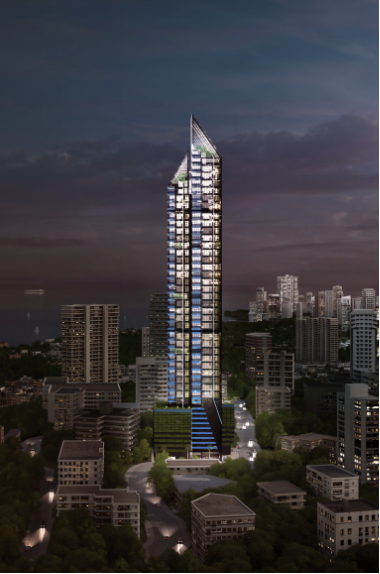
Altamount Road, Bombay. India's Tier-1 residential construction is converging on a common design language: reinforced concrete frames, sealed glass facades, single-aspect flats. Cooling load is priced into resident electricity bills, not into developer capex. Photo: Wikimedia Commons.
India produced 453 million tonnes of cement in the fiscal year ending March 2025, second only to China. A substantial share went into new residential and commercial construction in Tier-1 cities.
Walk through Lower Parel in Bombay, HITEC City in Hyderabad, Whitefield in Bengaluru, or Kharadi in Pune, and the newest towers converge on a common design language. Reinforced concrete frames, single-aspect flats, dark or reflective glass curtain walls, sealed openings, uninterrupted vertical facades running twenty to forty storeys. The Indian Green Building Council rating on the marketing brochure is usually Gold or Platinum. Measured indoor operative temperature at 3 pm in April, with the air conditioning off, is rarely reported.
Europe is currently the case study for what happens when residential stock is built on sealed-envelope logic for two centuries. The World Health Organization put the toll from the June 2026 European heat dome above 1,300 in ten days. Allianz Trade has modelled a cumulative European Union GDP drag of 5 to 7 percent by 2030. The retrofit programme required to install active cooling across European residential stock runs into the trillions of euros.
The question this brief works through is whether the construction currently going up in Indian cities is on a similar cost curve, and where the investable and policy leverage points sit.
- Why cement-and-glass has become the default in Indian Tier-1 residential, and the three forces reinforcing it.
- What Kerala Nalukettu and Rajasthani haveli measured performance actually records, and why MDPI Buildings studies 2023 to 2025 matter for the retrofit debate.
- The International Energy Agency demand curve: ninefold air-conditioning ownership growth by 2050, 45 percent of peak load by 2050, 180 gigawatts of new cooling load by 2035.
- The Indian innovation landscape already commercialised or piloted: district cooling at GIFT City, cement decarbonisation at UltraTech and Ambuja, passive-design certification via GRIHA and IGBC.
- The 2027 National Building Code revision cycle, and which state (Karnataka or Tamil Nadu) is most likely to move first.
The full study includes sourced figures from the International Energy Agency, MDPI Buildings, ICRA, the Cement Manufacturers Association of India, the Bureau of Energy Efficiency and the World Health Organization. It runs to about seven minutes of reading. It is published below.
Read the full brief
Tell me who you are. The brief opens immediately after you submit, and lands in your inbox so you have it later.